Skyline Bowling
- 4.5
- Rating
- 1.00M
- Installs
- Free
- Price

 Analysis by App-foxy
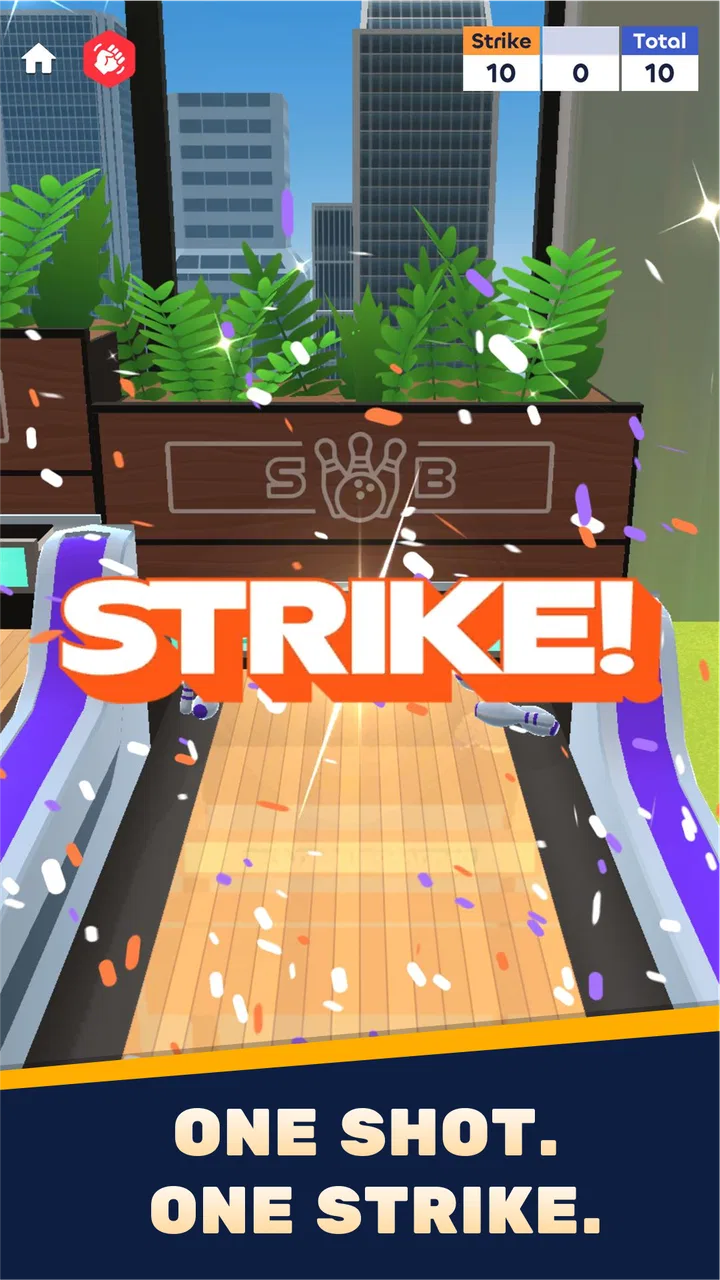
I expected Skyline Bowling to be a simple bowling game for filling a few spare minutes, but its appeal becomes clearer after several short sessions. The basic action is familiar: line up a shot, release the ball, watch it travel, and react to the result. What gives it a different personality is the way it places that familiar action inside unusual courses and adds special abilities. The result is less like a traditional bowling simulator and more like a compact sports challenge built around quick decisions.
That distinction matters. If you want a faithful recreation of a real bowling alley, this probably is not the first game I would suggest. If you enjoy arcade sports games where every attempt is easy to understand but still leaves room for improvement, it is much more inviting. I found myself returning not because each round was long or complicated, but because one imperfect throw naturally made me want to try again.
It is a free sports game from VOODOO, available for Android users on version 8.0 or later. The game is rated Teen, and its store page shows a 4.5 average from around 11 thousand ratings, with more than a million installs. Those figures suggest that its quick, accessible format has found a sizeable audience, but the real question is whether the loop remains enjoyable after the novelty of the first course wears off.
You May Also Like

 Google Keep - Notes and lists
Google Keep’s Quiet Growth Shows the Appeal of Simpler Notes
As mobile work gets busier, Google Keep keeps winning a simple contest: capture a thought quickly, find it later, and get on with the day.

 Blood Strike: 2.5 Anniversary
Blood Strike’s Loadouts Turn Every Drop Into a Tactical Gamble
A close look at Blood Strike’s custom loadouts: how fast access to signature weapons reshapes its battle royale rhythm, rewards preparation, and narrows the gap between fights.

 Pandora - Music & Podcasts
Pandora’s Music Is Easy to Start, but Harder to Recover
Pandora’s strength is its low-effort path from a seed to a station. Its weak spot is how much confidence it asks you to place in connection, setup, and quiet recovery.

 8 Ball Pool
 Is Built on Rivalries, Rematches, and Routine
A close look at the rivalries, rematches, shared routines, and unanswered safety questions that turn a quick pool match into a persistent mobile community.

 Samsung Music
’s Quiet Strength Is Playing What You Already Own
Its reach comes less from spectacle than from dependable access to a personal library. That simplicity is both the app’s strongest retention engine and its ceiling.

 AccuWeather: Weather Radar
AccuWeather Review: A Quick, Clear Forecast for Everyday Decisions
For everyday plans, the best forecast is the one you can understand quickly. AccuWeather makes rain timing, radar, and local conditions easy to act on, with a few trade-offs.
More From Our News Desk



How the first throw sets up the whole experience
I like to treat the opening throw as a quick read of the course, not a test I have to ace immediately. That gives me a low-pressure way to notice which parts of the route deserve attention before I commit to a bolder attempt. Once I have that first impression, the next section looks at the small setup checks that can make a session feel smoother.
The first action is deliberately easy to understand
The strongest part of the opening experience is that I never had to spend much time learning what to do. Bowling games live or die by the quality of their central gesture, and here the intention is immediately clear: aim, commit to the throw, and read the result. That simplicity makes the game approachable when I have only a minute or two, while the changing situations keep it from feeling like I am repeating exactly the same shot.
The unusual maps are important because they change how I think about the lane. In a conventional bowling game, I would mainly consider angle, power, and the position of the pins. Here, the surrounding course becomes part of the challenge. I pay attention to the route, the available space, and the way a special ability might alter the best approach. That gives each attempt a small puzzle element without turning the game into a slow strategy title.
I also like that the action is readable on a small phone screen. The essential information is concentrated around the shot itself, so I can make a decision without feeling buried under menus. This is especially useful when playing one-handed during a short break. The trade-off is that players who want detailed control over every aspect of a bowling throw may find the experience intentionally light.
What to watch before releasing the ball
My most useful adjustment was to stop treating every shot as a straight race toward the pins. The map is not just decoration. Before releasing the ball, I look for the safest line rather than automatically choosing the most direct one. A slightly less ambitious route can produce a better result if it avoids a difficult section or makes better use of the ability available in that attempt.
This is one of the game's less obvious strengths: it rewards a brief pause before acting. The pause does not need to become a long planning session. I usually need only a moment to identify the intended path and decide whether I am trying to secure a reliable result or gamble on a more dramatic one. That choice gives the simple control scheme more depth than the first few throws suggest.
For new players, I would recommend learning the feel of the basic throw before experimenting too aggressively with special abilities. It is tempting to use every unusual tool immediately, but understanding the normal path makes it easier to judge whether an ability is solving a real problem or merely making the shot look more exciting. That small discipline also reduces wasted attempts.
Why the feedback arrives so quickly
The game communicates success and failure through the immediate result of each throw. A good attempt feels rewarding because I can see the consequences without waiting through a long sequence of menus. A poor attempt is equally useful: it shows me that my line, timing, or choice of ability needs changing. This quick feedback is the foundation of the entire experience.
That rhythm makes the game comfortable for casual play. I can make a mistake, understand it, and try a different approach almost immediately. In a slower bowling simulation, a failed shot might feel like part of a long match. Here, it feels more like information for the next attempt. The difference is subtle, but it is why I find the game easier to pick up repeatedly.
The role of special abilities
Special abilities prevent the game from becoming only a test of ordinary bowling technique. They give me another decision to make: should I use an ability now to protect a promising run, or hold it for a situation where the course is more demanding? That decision adds tension to otherwise familiar actions.
I would not describe the abilities as a replacement for aiming. They work best when they support a sensible plan. Used without considering the map, they can feel like a shortcut that postpones the real lesson. Used at the right moment, they turn a difficult attempt into a satisfying recovery. For me, the best moments come when the ability changes the risk of a shot rather than removing the need to think about it.
There is also a useful trade-off between experimentation and consistency. Trying different abilities can reveal more interesting ways through a course, but relying on them too heavily may make ordinary throws feel less meaningful. I prefer alternating between safe attempts and deliberate experiments. That approach keeps the game fresh without making every round feel random.
When the reward feels earned
The reward in Skyline Bowling is not only the immediate pleasure of knocking down pins. It is also the sense that I have understood a course better than I did a few moments earlier. A successful attempt after changing my angle or saving an ability feels more satisfying than a lucky result because I can identify the decision that made the difference.
This is where the game separates itself from a basic bowling toy. The reward is connected to learning the shape of the challenge. I gradually build a mental note of which routes are comfortable, which shots are risky, and when a special ability is worth spending. Even without a long play session, that small improvement gives the next attempt a reason to exist.
The free entry point also makes it easy to test that loop without committing money first. Optional purchases range from $0.49 to $134.99 per item, so I would advise treating them carefully and deciding in advance how much the game is worth to you. The core appeal for me comes from the throw-and-retry cycle, not from feeling pressured to buy something after a difficult attempt.
A realistic everyday session
Imagine waiting for a coffee or sitting on a train with a few minutes available. I can open the game, make a handful of attempts, and put it away without needing to remember a complicated storyline or manage a long-term team. If the first shot goes badly, the next one is close enough that restarting does not feel like a major commitment. If a route goes well, I can stop while the result still feels satisfying.
That makes it a better fit for fragmented time than many traditional sports games. I would choose it when I want direct interaction and quick feedback rather than a full match. The same quality can become a limitation, though. Players looking for a deep career mode, realistic league structure, or extended competitive matches may find the short arcade format too narrow.
Resetting without losing the reason to continue
The reset is central to the game's appeal. After an unsuccessful attempt, I am not left with a long recovery process. I can rethink the shot and return to the action quickly. That low cost of failure encourages experimentation, which is exactly what the unusual maps and abilities need.
A good reset should make me curious rather than frustrated, and this one generally succeeds because the cause of failure is close to the action. I can usually connect the result with a decision I made: perhaps I chose a poor line, committed too early, or used an ability without enough purpose. That connection matters more than simply being allowed to retry. It turns failure into a practical hint.
There is a point where repetition may become less appealing, especially for someone who prefers steady progression over repeated attempts. The game’s structure is strongest when I am actively testing ideas. If I am not interested in refining a shot or exploring a different route, the reset can start to feel like the same invitation arriving again. That is why I see it as a focused arcade experience rather than a complete substitute for a larger sports game.
How it compares with ordinary bowling alternatives
Compared with a realistic bowling simulator, this game asks less of me in terms of rules, match management, and technical detail. That is a benefit when I want immediate action, but a weakness if I enjoy the measured pace of choosing a ball, reading a lane, and managing a full frame-by-frame performance. The unusual maps and abilities give this title more variety than a plain virtual alley, but they also move it away from authentic bowling.
Compared with other casual sports games, it has a clearer central gesture. I am not managing a squad, memorizing a large control layout, or waiting for a long event to finish. The focus stays on one attempt at a time. That makes it approachable, although players who want social competition, extensive customization, or a broad collection of sports may prefer a larger package.
I would also distinguish it from a purely reflex-based arcade game. Speed can help, but the most satisfying progress comes from reading the course and making a deliberate choice. If you enjoy games that combine a simple physical action with light route planning, this sits in a comfortable middle ground. If you want either serious simulation or nonstop twitch action, it may land between those expectations.
Small habits that improve the experience
My first practical tip is to treat the opening attempt on a new map as reconnaissance. Instead of forcing the most ambitious shot, I use it to understand the route and the consequences of a miss. That makes later attempts more purposeful and avoids spending abilities simply because they are available.
Second, I try not to judge an ability by how dramatic it looks. Its value is measured by whether it improves the decision in front of me. Saving one for a difficult section can be more useful than spending it on a shot that was already comfortable. This is an easy habit to overlook because the game encourages immediate action.
Third, I separate unlucky results from poor planning. If the route was sensible and the outcome was merely disappointing, I may repeat the idea with a small adjustment. If the route itself was unrealistic, I change the plan rather than making the same throw with more force. That distinction helps the reset loop teach me something instead of becoming blind repetition.
Finally, I recommend short sessions rather than forcing a long one. The game’s feedback is sharpest when I am still curious about the next attempt. Once I start making throws without considering the map, the experience loses some of its charm. Stopping and returning later works well because the controls are easy to pick up again.
Who should play it, and who should skip it
I think Skyline Bowling is a good choice for someone who wants a free, compact sports game with more personality than a standard bowling lane. It suits players who enjoy trying a shot, seeing the result, adjusting a plan, and immediately testing that adjustment. It is also a sensible option for casual players who do not want a demanding tutorial or a large time commitment.
I would be more cautious about recommending it to someone who expects a serious bowling simulation. The arcade structure, unusual courses, and special abilities are the point, not side features. They make the game more playful, but they also mean that real-world bowling technique is only part of the experience. A player seeking full sporting authenticity would probably be happier with a dedicated simulator.
I would also skip it if repeated retries are not enjoyable for you. The game depends on the desire to begin another attempt after a miss. Without that motivation, the short sessions can feel thin. Likewise, anyone uncomfortable with optional in-app purchases should keep an eye on the purchase range and decide beforehand whether the free experience is enough for their needs.
Device fit and practical expectations
The Android requirement is modest, with support beginning at version 8.0, which makes it accessible to people who are not using the newest phone. I still prefer playing with a stable grip and enough screen space to make the aiming action comfortable. On a very small display, the map may feel more cramped, while a larger phone makes it easier to read the route before committing.
The Teen content rating is another reason parents should consider whether the game suits the intended player rather than assuming every bowling title is automatically suitable for children. The rating is worth checking before installation, particularly on a shared device. For adult casual players, it does not change the basic appeal: the game remains centered on quick sports challenges rather than a long narrative.
My verdict on the complete loop
The loop works because every stage supports the next one. I take an action by setting up a throw, receive immediate feedback from the result, earn the satisfaction of a successful route or a useful lesson from a miss, and then face a reset that is quick enough to invite another attempt. The reason to continue is not simply that the game tells me to do so; it is that I can see a better decision waiting to be tested.
That design is more compelling than the short store summary might suggest, but it has a clear audience. I would recommend it to friends who want an arcade bowling game with unusual courses, light tactical choices, and sessions that fit around everyday interruptions. I would not present it as a replacement for a realistic bowling simulator or a deep sports career game.
After spending time with it, my opinion is positive but measured. The action is accessible, the feedback arrives at the right speed, and the reset makes failure feel manageable. Its main limitation is also its identity: everything is built around repeating compact attempts. If that rhythm sounds appealing, the free download is an easy one to try. If you need long-form progression or authentic bowling detail, choose a different kind of sports game instead.
FAQs for Skyline Bowling
01What is Skyline Bowling and how does it differ from other bowling games?
Skyline Bowling is an immersive bowling game available on Android and iOS that offers a unique urban setting with stunning cityscapes. Unlike traditional bowling games, it features diverse locations, customizable bowling balls, and realistic physics. The game combines casual play with competitive tournaments, making it appealing for both casual and serious gamers.
02Is Skyline Bowling free to play, or does it require in-app purchases?
Skyline Bowling is free to download and play, but it includes optional in-app purchases. These purchases allow players to unlock premium features, such as exclusive bowling balls, special power-ups, and advanced levels. While in-app purchases enhance the gaming experience, they are not necessary to enjoy the core gameplay.
03What are the minimum device requirements for Skyline Bowling?
For Android devices, Skyline Bowling requires at least Android version 5.0 and 2GB of RAM for optimal performance. For iOS users, the game is compatible with iOS 11.0 or later, and it is best experienced on devices with at least an A9 processor. A stable internet connection is recommended for accessing all features.
04Does Skyline Bowling offer multiplayer options?
Yes, Skyline Bowling includes both local and online multiplayer modes. Players can compete with friends on a single device or challenge other players worldwide in real-time matches. The game also features leaderboards and tournaments, allowing players to track their progress and compete for top rankings.
05How can players improve their skills in Skyline Bowling?
Players can enhance their skills by practicing in the game’s various modes, such as practice lanes and skill challenges. The game also offers tutorials and tips on mastering techniques like spin control and aiming. Engaging in regular gameplay helps players refine their strategies and improve their overall performance.
Pros
- Intuitive controls make gameplay easy.
- Vibrant graphics enhance user experience.
- Wide variety of bowling alleys available.
- Engaging multiplayer mode for challenges.
- Regular updates with new features.
Cons
- In-app ads can be intrusive at times.
- Limited free customization options.
- Occasional lag on older devices.
- Requires a constant internet connection.
- Some features are locked behind paywalls.

Skyline Bowling
Gallery